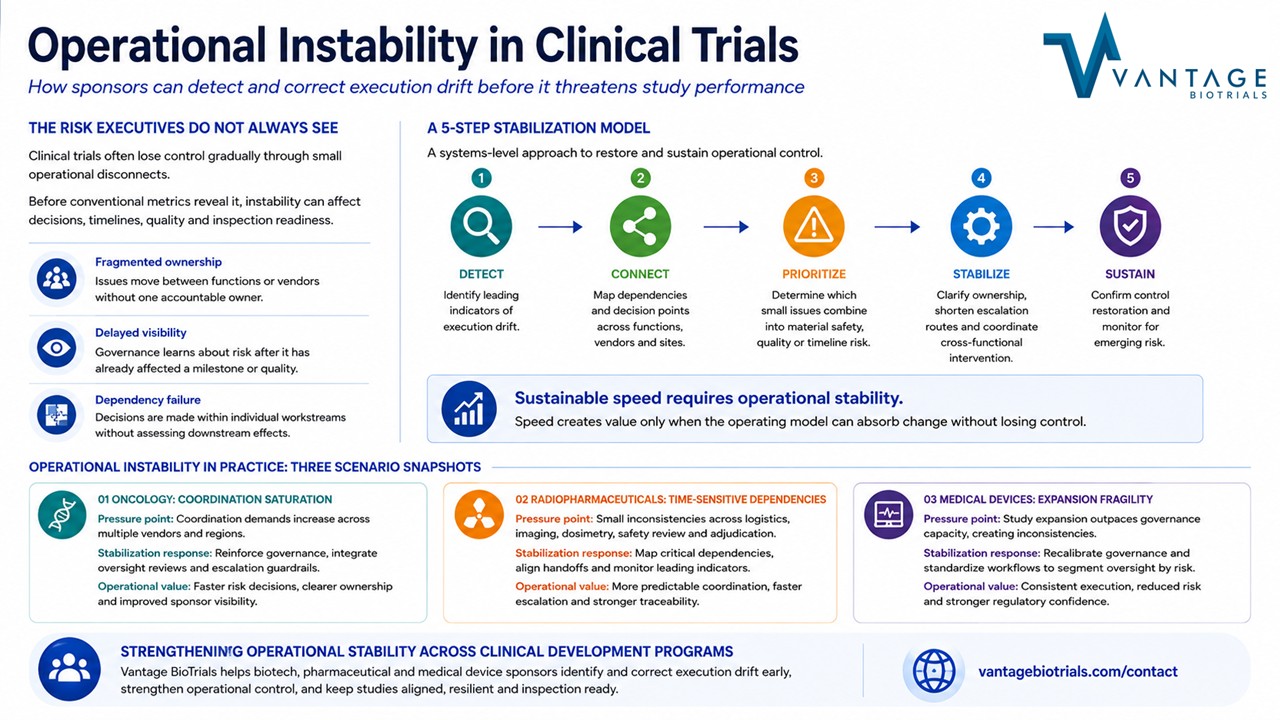
The risk executives do not always see
Clinical trials are increasingly complex operating systems. Sponsors, CROs, sites, laboratories, imaging providers, technology platforms and logistics partners may each perform their assigned work while the study as a whole gradually loses alignment.
By the time execution drift appears in conventional performance metrics, the underlying instability may already be affecting decisions, timelines and oversight. The warning signs are often familiar:
§ Fragmented ownership — issues move between functions or vendors without one accountable decision owner.
§ Delayed visibility — governance learns about risk after it has already affected a milestone, patient visit or quality deliverable.
§ Dependency failure — decisions are made within individual workstreams without assessing downstream effects.
§ Control fatigue — meetings and reports continue, but they no longer generate timely decisions or durable corrective action.
Sustainable speed requires operational stability
Stability is not an alternative to speed. It is what allows a study to move quickly without creating rework, escalation backlogs, inconsistent execution or quality debt. Compressed timelines become commercially valuable only when the operating model can absorb change without losing control.
EXECUTIVE TAKEAWAY The relevant question is not whether individual teams are busy or milestones remain nominally on track. It is whether the study can continue making coordinated, risk-informed decisions as pressure and complexity increase. |
A systems-level stabilization model
Vantage BioTrials (VBT) approaches instability as a management discipline. Rather than treating each issue as an isolated task, VBT examines how operational dependencies interact across the sponsor, CRO, sites and vendors.
Stage | Management objective |
1 | Detect | Identify leading indicators of execution drift before milestone failure. |
2 | Connect | Map dependencies and decision points across functions, vendors and sites. |
3 | Prioritize | Determine which small issues could combine into material safety, quality or timeline risk. |
4 | Stabilize | Clarify ownership, shorten escalation routes and coordinate cross-functional intervention. |
5 | Sustain | Confirm that control has been restored and monitor for emerging risk elsewhere in the system. |
Operational instability in practice
The following scenarios illustrate how instability can emerge in complex programs and how an integrated response can restore operational control. They are presented as operational scenarios, not as quantified client case studies.
OPERATIONAL SCENARIO 01
Oncology: coordination saturation
The pressure point: A global oncology study relies on multiple vendors, regional teams and decentralized systems. As coordination demands increase, communication slows, escalation pathways lengthen and operational ownership becomes fragmented.
What conventional oversight can miss: Each function may remain active and individually compliant while cross-functional variability grows. More status reporting does not necessarily produce better decisions.
The stabilization response: Reinforce centralized decision governance, integrate oversight reviews across vendors and regions, assign accountable owners to cross-functional risks and introduce time-bound escalation criteria.
Operational value: Faster risk decisions, clearer ownership and improved sponsor visibility across an otherwise fragmented operating environment.
OPERATIONAL SCENARIO 02
Radiopharmaceuticals: time-sensitive dependencies
The pressure point: Minor inconsistencies arise across shipment coordination, patient scheduling, imaging, dosimetry, safety review and adjudication of radiation-related findings. Individually, each issue appears manageable; collectively, they reduce workflow predictability within narrow operational tolerance windows.
What conventional oversight can miss: A workstream-by-workstream response overlooks the dependency chain. A logistics delay can affect administration, imaging, dosimetry and safety decisions even when every provider follows its own procedure.
The stabilization response: Map the end-to-end critical path, identify propagation points, align logistics, clinical operations, imaging and safety through one oversight cadence and use leading indicators to escalate risk before a patient visit or treatment window is affected.
Operational value: More predictable coordination, faster escalation of time-sensitive risk and stronger traceability across clinical and logistics decisions.
OPERATIONAL SCENARIO 03
Medical devices: expansion fragility
The pressure point: A medical device sponsor expands its global footprint following early enrollment success. Site and vendor activity grows faster than governance capacity, producing inconsistencies in documentation, oversight and execution.
What conventional oversight can miss: Enrollment and activity metrics can remain positive while standardization and inspection readiness deteriorate beneath the surface.
The stabilization response: Recalibrate governance to the expanded footprint, standardize critical workflows, segment oversight according to risk and reinforce inspection readiness while growth continues.
Operational value: Scalable execution that protects momentum without allowing operational growth to outpace quality control.
What Vantage BioTrials does differently
Vantage BioTrials does not assume that more meetings, more reports or more people will stabilize a study. The objective is to create the smallest effective control structure around the points where operational risk can propagate.
§ Leading indicators over lagging metrics — detect emerging instability before it becomes a missed milestone.
§ Dependency mapping over functional silos — manage the interactions between workstreams, not only the performance within them.
§ Decision velocity over reporting volume — design governance to convert information into accountable action.
§ Targeted intervention over unnecessary disruption — strengthen an existing CRO and vendor ecosystem or lead clinical trial management directly.
§ Senior-level engagement over layered handoffs — keep experienced decision-makers close to the study and its changing risk profile.
The small-CRO advantage
As a specialized clinical trial management CRO, VBT can operate across functional boundaries without the layers that often slow issue recognition and decision-making. Senior personnel remain directly engaged, governance is adapted to the study rather than imposed from a fixed template and resources can be concentrated where operational pressure is highest.
This allows VBT to serve either as the sponsor’s clinical trial management partner or as a focused stabilization layer within an established CRO and vendor structure—without requiring wholesale replacement of existing providers.
A practical executive test
A study may be developing execution drift when:
§ the same issues recur after being marked resolved;
§ risks are discussed repeatedly without a clear decision owner;
§ vendors meet their individual metrics while cross-functional milestones remain vulnerable;
§ reports describe activity but do not reveal how risks interact; or
§ inspection readiness depends on a late-stage remediation effort rather than continuous control.
THE VANTAGE POINT Clinical trial instability is rarely solved by asking individual teams to work harder. It requires visibility across the operating system, an understanding of how risks interact and governance capable of converting information into timely decisions. |